

Luna
Artist: Janus
Title: Luna
Technique: Mixed technique with ducats double gold 23 carat, glowing in the night
Size: 80 × 60 cm
Date: 2026
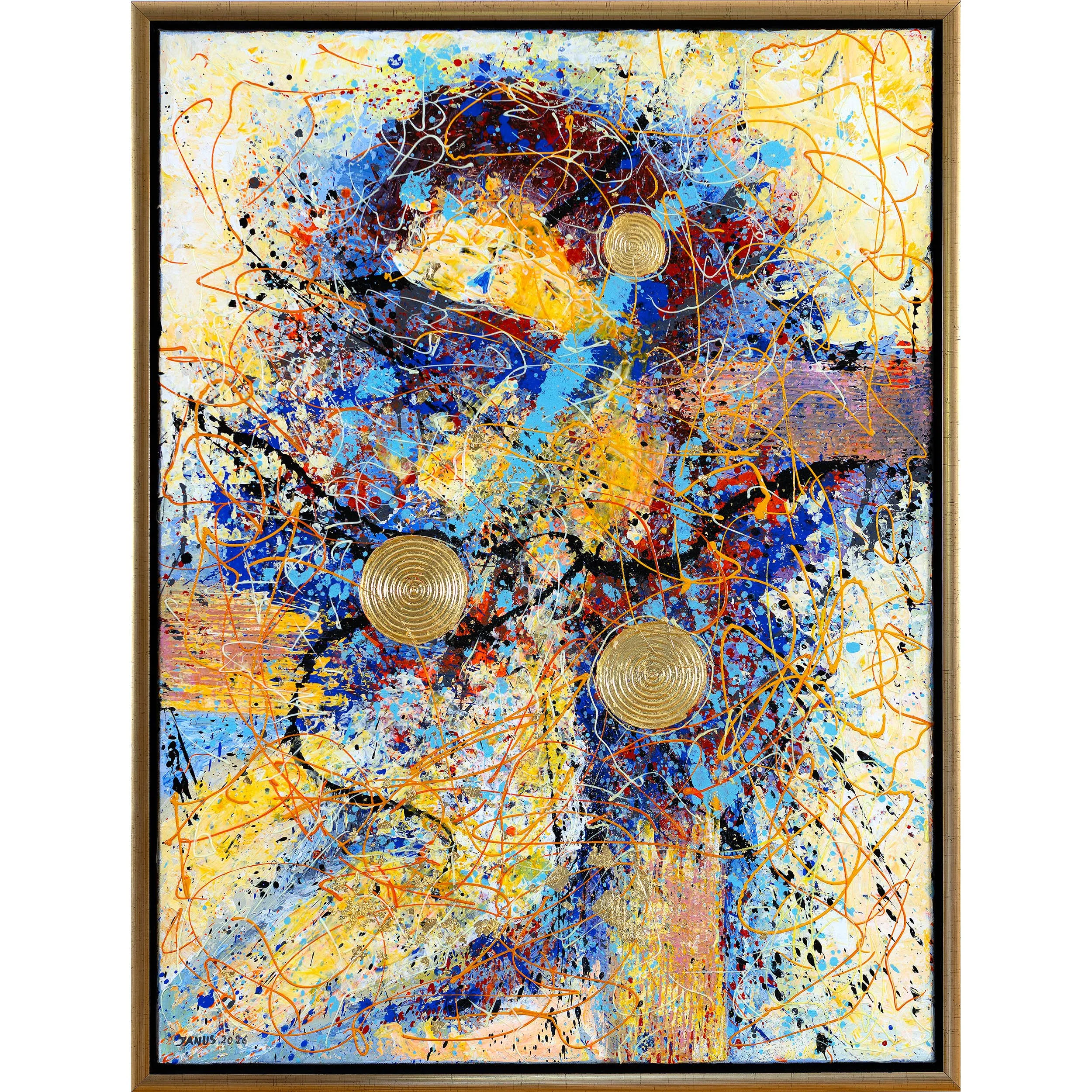
“Luna” by Janus is a painting about light that not only enables us to see, but also reveals what is hidden. Its title evokes the Moon, an eternal symbol of mystery, intuition, transformation, and the realm between waking consciousness and dreams. Just as the Moon changes its appearance while remaining the same celestial body, “Luna” reveals several different realities contained within a single painting.
In daylight, the composition pulsates with extraordinary intensity. Blues, oranges, reds, whites and blacks collide, merge and swirl, creating a space reminiscent of cosmic matter in constant motion. Delicate, freely drawn lines cross the surface like trajectories of invisible particles, traces of movement, or paths of energy circulating between forms.
Within this apparent spontaneity appear the circles of 23-carat gold that are characteristic of Janus’s work. They are like points of stillness within the elemental movement, planets, lunar discs, but also symbolic centres of energy. According to observations reported by bioenergy therapists, these circles concentrate positive, healing energy and transmit it to the viewer. In an artistic sense, they can be understood as places of concentration and harmony, points around which chaos begins to discover its own order.
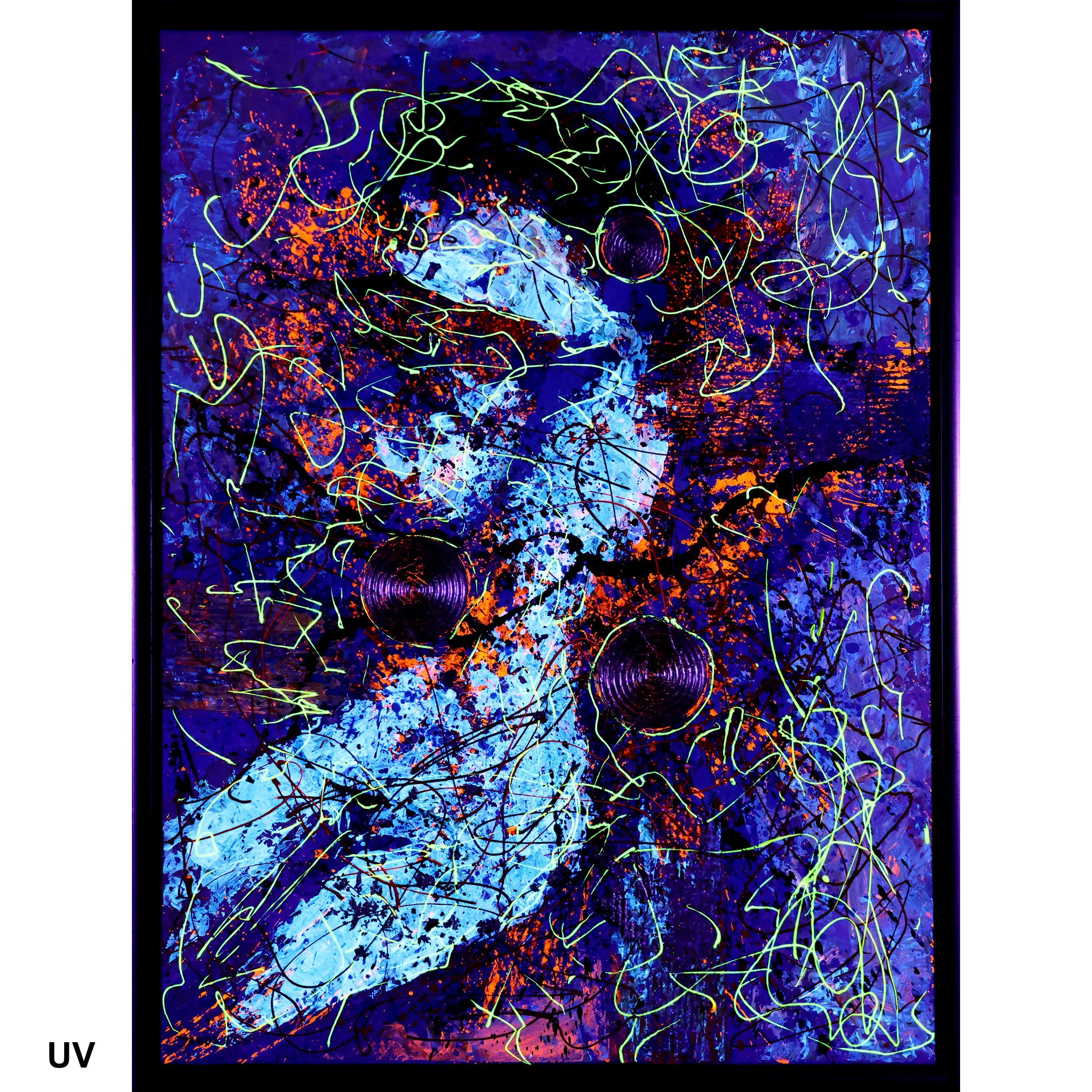
Yet the true mystery of “Luna” is revealed only when the light changes.
Under UV light, the familiar painting undergoes an extraordinary metamorphosis. The brightness of day gives way to deep blues, violets and darkness. Fluorescent lines and forms emerge from this nocturnal space, revealing elements that were almost invisible before. The composition begins to resemble a night sky perceived not through the eyes, but through the imagination. What appeared in daylight as a painterly gesture now becomes a luminous network of connections, as though another reality existed beneath the visible surface of the world.
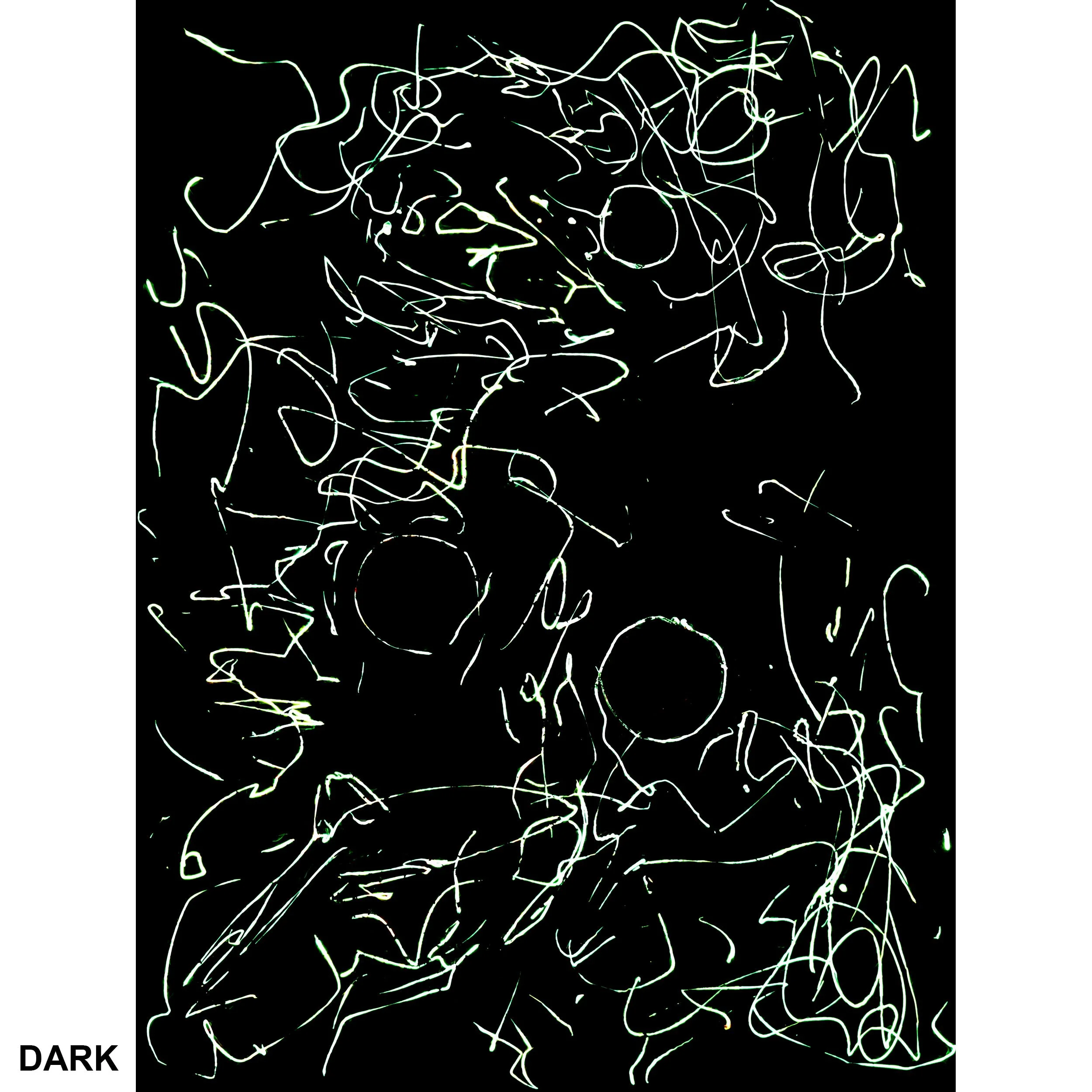
An even more profound transformation occurs in complete darkness. Colour and matter almost disappear. What remains are luminous lines, delicate, fragile and suspended in blackness. The painting ceases to feel like a physical object and becomes something closer to a trace, an impulse, a record of the invisible. It is as though, after the material world has vanished, only the energy of its existence remains.
It is here that the title “Luna” acquires its deepest meaning. The Moon produces no light of its own, it becomes visible through the light it receives and reflects. In a similar way, Janus’s painting changes according to the light that reaches it. There is therefore no single, definitive face of the work. Each form of illumination reveals another layer of the same reality.
In this sense, “Luna” also becomes a metaphor for the human being. We too reveal to the world what can be seen on the surface, while deeper within us exist emotions, memories, intuition and energy that cannot be perceived at first glance.
Perhaps this is why “Luna” is not really a painting about the Moon as an object in the night sky. It is instead a meditation on the light hidden within darkness, and on the possibility that even when everything familiar and visible disappears, a delicate trace of light still remains.