

Fortuna’s Wheel
Artist: Janus
Title: Fortuna’s Wheel
Technique: Mixed technique with ducats double gold 23 carat, glowing in the night
Size: 80 × 80 cm
Date: 2026
Janus’s “Fortuna’s Wheel” is a meditation on the mutability of fate, on an invisible force that keeps human existence in constant motion. At times it carries us towards the light; at others, it leads us into uncertainty. Fortune’s wheel never truly stops turning.
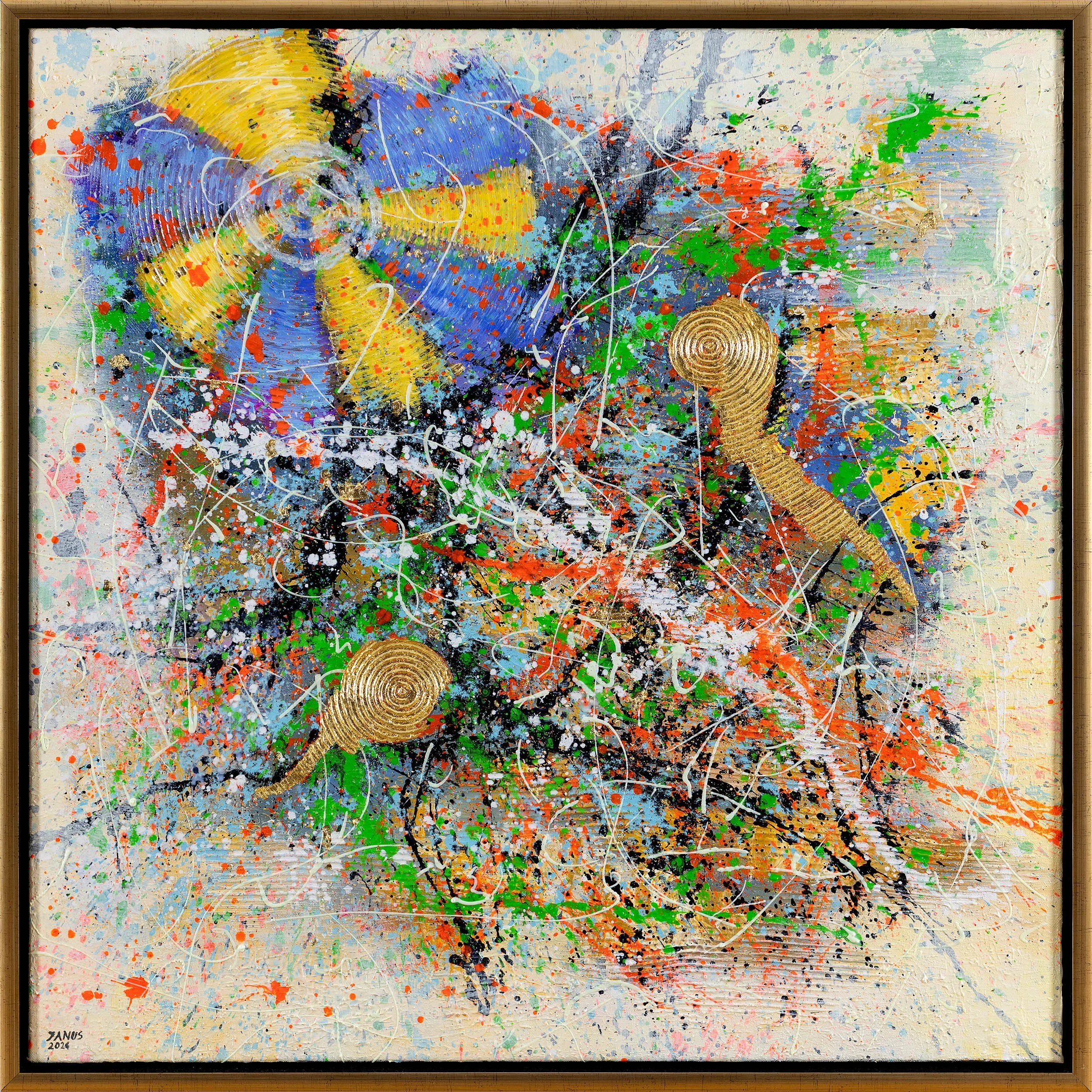
In natural daylight, the painting radiates extraordinary vitality. Yellow, blue, red and vivid green collide, overlap and penetrate one another. Lines travel in different directions like the paths of human lives: they cross, separate, turn back and form temporary knots, only to break free and continue their journey.
In the upper left area of the composition, a distinct circular movement emerges. It can be perceived as Fortune’s Wheel itself – a vortex of time, chance and destiny. Yet it is not a perfect, enclosed circle. Its boundaries dissolve into the surrounding pictorial matter, as though fate itself had neither a clearly defined beginning nor an end.
The golden forms play a particularly significant role. Their spiral structures evoke energy gathering around an inner centre. Gold becomes a material, almost earthly point of stability within the turbulent flow of colour. It may symbolise everything we try to preserve against the power of chance: our values, memories, inner strength, perhaps even our sense of self.
But Fortune transforms the painting just as it transforms human life.
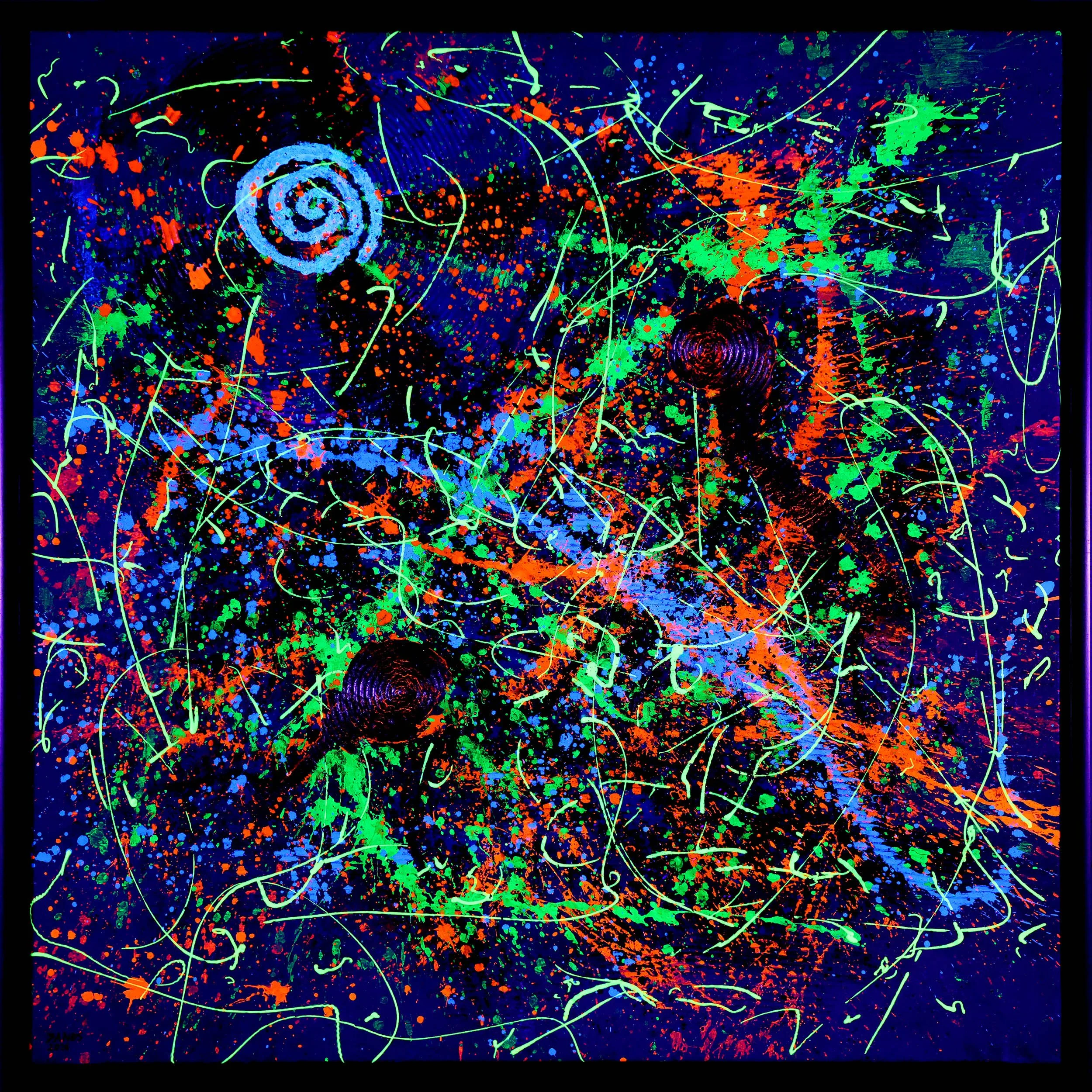
Under UV light, a second reality is revealed. The calmer areas of the daylight composition give way to an intense, almost cosmic space. Green, orange, violet and blue begin to pulsate. Lines that could previously pass unnoticed suddenly move to the foreground. What was concealed becomes visible.
This transformation can be understood as a metaphor for reality itself: we never perceive it in its entirety. The same event, the same person, the same moment may appear completely different when the conditions of perception change. Fortune does not necessarily change the world – sometimes it merely changes the light in which we see it.
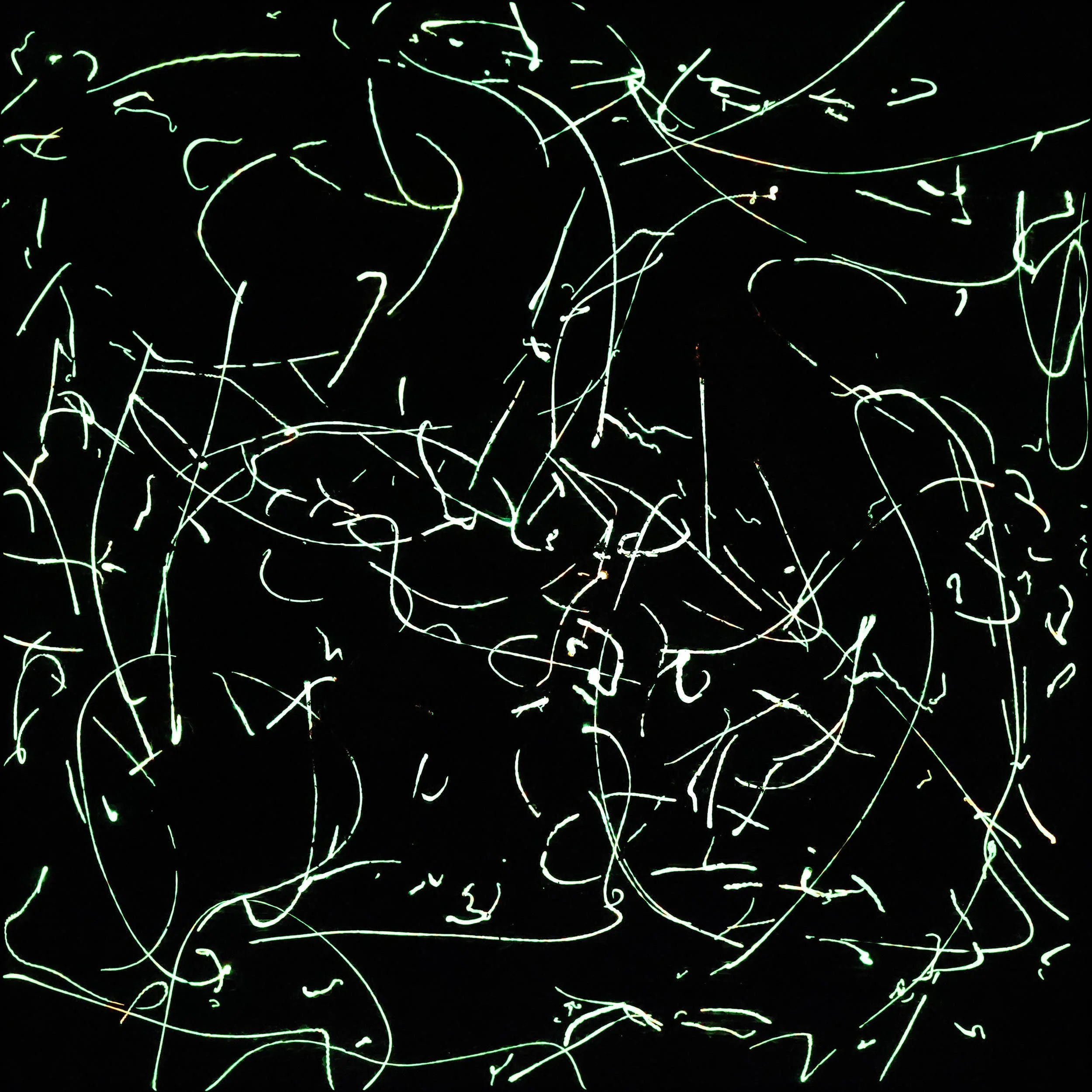
Yet the most haunting transformation takes place in complete darkness.
Colour almost entirely disappears. From the richness of the painted surface, only a delicate network of phosphorescent lines remains. The painting seems to lose its physical body. The gold is no longer visible; the explosions of red and the multicoloured structures have vanished. What remains is a trace.
These luminous lines resemble a record of the paths we have travelled, encounters, decisions, coincidences and moments that have permanently altered the direction of our lives. Some lines end abruptly, others continue across great distances, while others intersect only for an instant.
It is here that “Fortuna’s Wheel” acquires its most poetic dimension. In absolute darkness, Fortune’s Wheel itself almost disappears, yet the movement remains.
It is as though Janus were suggesting that when the external world falls into darkness, an invisible record of our existence survives, the energy of lived moments, memory, and the traces of all the paths along which fate has carried us.
“Fortuna’s Wheel” does not answer whether we control our own lives or whether we are ultimately subject to chance. Instead, it leaves the viewer suspended between these two possibilities.
Perhaps this is precisely the mystery of Fortuna:
we never know where the wheel will turn next but every turn leaves its trace within us.